
Nevada mines more gold than any other state, about 64% of all the gold mined in the US in 2025, according to the U.S. Geological Survey. Most of it comes from giant open pits and underground mines along the Carlin Trend and the Battle Mountain–Eureka Trend in northern Nevada, run by Nevada Gold Mines (Barrick and Newmont), Kinross, SSR Mining and a few smaller companies.
Those big mines sit next to thousands of older ones. Nevada is covered in historic districts, ghost towns and abandoned shafts, and much of the ground around them is still claimed today. Our Nevada mining claims map shows where those claims are, so you can see what’s taken and what’s open before you head out.
Gold mines in Nevada today
Nevada’s mines produced 3,479,748 ounces of gold in 2024, worth about $8.3 billion, according to the state’s yearly Major Mines of Nevada report. That was down 13.7% from just over 4 million ounces in 2023, but Nevada was still far ahead of every other state. If Nevada were its own country, it would rank about 10th in the world.
The US produced an estimated 160 metric tons of gold in 2025, and Alaska was a distant second to Nevada at about 22% (USGS, Mineral Commodity Summaries 2026). Almost all of Nevada’s gold comes from large hard rock mines that move huge amounts of low-grade ore. You won’t see big nuggets at these mines. The gold is mostly too fine to see, and it’s pulled out of the rock with chemistry, not a pan.
Nevada’s biggest gold mines by production
These are the mines that reported the most gold to the state for 2024, the newest full list. About 25 mines and mine complexes reported some gold that year.
| Mine | Operator | Near | Gold in 2024 (oz) |
|---|---|---|---|
| Carlin (Eastern Nevada Operations) | Nevada Gold Mines | Carlin | 786,129 |
| Turquoise Ridge and Twin Creeks | Nevada Gold Mines | Golconda | 494,241 |
| Pipeline and Cortez Hills open pit | Nevada Gold Mines | Crescent Valley | 306,124 |
| Cortez Hills underground | Nevada Gold Mines | Crescent Valley | 280,345 |
| Meikle (Goldstrike underground) | Nevada Gold Mines | north of Carlin | 226,846 |
| Round Mountain | Kinross | Round Mountain | 211,716 |
| Betze-Post (Goldstrike open pit) | Nevada Gold Mines | north of Carlin | 191,101 |
| Bald Mountain | Kinross | south of Elko | 180,660 |
| Marigold | SSR Mining | Valmy | 168,262 |
| Goldrush | Nevada Gold Mines | Crescent Valley | 130,485 |
| Phoenix | Nevada Gold Mines | Battle Mountain | 127,118 |
| Florida Canyon | Florida Canyon Mining | Imlay | 74,726 |
| Arturo | Nevada Gold Mines | north of Carlin | 61,718 |
| Robinson (mostly copper) | KGHM | Ruth | 45,141 |
| Gold Bar | McEwen Mining | Eureka | 44,574 |
| Rochester (mostly silver) | Coeur | Lovelock | 39,203 |
| Granite Creek | i-80 Gold | Golconda | 38,000 |
| Pan | Calibre | Ely | 35,267 |
| Isabella Pearl | Fortitude Gold | Mina | 16,472 |
Source: Nevada Division of Minerals and Nevada Bureau of Mines and Geology, Major Mines of Nevada 2024 (2025). A few small producers aren’t shown, including Long Canyon (8,839 oz), Lone Tree (6,200 oz) and Ruby Hill (3,200 oz).
Nevada Gold Mines alone reported 2,612,946 ounces in 2024, which is about three out of every four ounces mined in the state. Kinross came next with 392,376 ounces from Round Mountain and Bald Mountain combined.
The Carlin Trend
The Carlin Trend runs northwest of the town of Carlin in Elko and Eureka counties. Newmont geologists found the first deposit here in 1961, and the Carlin mine poured its first gold in 1965. The gold is so fine it can’t be seen with the naked eye, which is why prospectors walked past it for nearly a century. The trend passed 50 million ounces of production back in 2002, and it’s still one of the richest gold belts in the world.
The Carlin complex today includes the Goldstrike mine (Betze-Post and Meikle) and the old Newmont Carlin pits. As the table shows, it’s the single biggest producer in the state.
The Battle Mountain–Eureka Trend
This belt runs southeast from the town of Battle Mountain toward Eureka. It holds the Cortez mines in Lander and Eureka counties, the Phoenix mine south of Battle Mountain, and the Marigold mine near Valmy. Cortez is also where Nevada Gold Mines is building up the Goldrush underground mine, which reported 130,485 ounces in 2024.
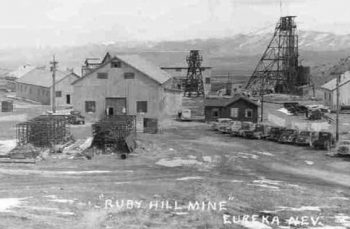 At the south end of the trend is the old mining town of Eureka, and the Ruby Hill mine shown here sits just outside it. Ruby Hill is a small producer now, with 3,200 ounces reported for 2024.
The Getchell Trend and the Walker Lane
Northeast of Winnemucca, near Golconda, the Getchell Trend holds Turquoise Ridge, Twin Creeks and the smaller Granite Creek mine. Out west, the Walker Lane follows Nevada’s border with California. It’s home to many of the state’s famous old camps, like the Comstock, Tonopah and Goldfield, and to newer projects in the Goldfield and Beatty areas.
Who runs the big mines
- Nevada Gold Mines: a joint venture formed on July 1, 2019, that combined Barrick’s and Newmont’s Nevada mines. Barrick runs it and owns 61.5%, and Newmont owns the other 38.5%. Its working mines are Carlin (including Goldstrike), Cortez (including Goldrush), Turquoise Ridge (including Twin Creeks) and Phoenix. Long Canyon, near Wells, went on care and maintenance at the end of 2023.
- Round Mountain (Kinross): a big open pit in Nye County, in Big Smoky Valley. Kinross called 2025 a transition year while it moved into a new part of the pit, and output dropped to about 143,400 gold-equivalent ounces.
- Bald Mountain (Kinross): an open pit mine in White Pine County, south of Elko.
- Marigold (SSR Mining): an open pit heap leach mine near Valmy in Humboldt County.
- Florida Canyon (Integra Resources): a heap leach mine near Imlay in Pershing County. Integra bought it in November 2024, and it produced about 70,900 ounces in 2025.
Barrick also owns Fourmile, a large new discovery next to Goldrush that isn’t a working mine yet. Companies open, pause and restart Nevada mines all the time, so treat this list as a snapshot from late 2026.
How much gold is left
The larger Nevada mines reported about 65.2 million ounces of gold reserves at the end of 2024. Reserves are the part of a deposit a company can mine at a profit with today’s prices and costs. The state estimates that’s enough to keep mining near today’s pace for about 19 years, and that number tends to grow when gold prices rise and companies keep drilling. Nevada Gold Mines’ Carlin, Turquoise Ridge and Cortez complexes each reported between about 13.5 and 15.4 million ounces.
Types of gold deposits in Nevada
Nevada’s gold shows up in three main ways, and each one calls for a different kind of mining.
- Invisible gold in sedimentary rock (Carlin-type): tiny specks of gold spread through limestone and similar rock, mostly in the northeast along the Carlin, Battle Mountain–Eureka and Getchell trends. This is where most of the state’s gold comes from today. You need big equipment and chemistry to get it out.
- Vein gold in old volcanic rock: richer veins of gold and silver, like the Comstock Lode, Goldfield, Tonopah, Aurora and Round Mountain. These built Nevada’s famous boom towns, and they’re the kind of ground hard rock prospectors still look at.
- Placer gold: loose gold in gravel that washed out of those veins. A 1973 USGS report (Bulletin 1356) counted 115 placer districts in Nevada that produced at least 1.7 million ounces of placer gold from 1849 to 1968. Manhattan, Round Mountain, Battle Mountain, Spring Valley and Silver City all had dredges at one point.
Placer gold is the kind most hobby prospectors chase, because you can find it with a metal detector or a dry washer.
Historic Nevada gold mines
From 1859 through 1965, Nevada’s mines produced a total of about 27.5 million ounces of gold, according to a 1968 USGS summary. Today’s mines produced 3.48 million ounces in 2024 alone, so they now pull out as much gold in about eight years as the old-timers did in more than a century.
The story of how Nevada got here, from the first finds at Gold Canyon to the rushes that built the state, is told in our Nevada gold rush article. Here’s where the best-known old mines and districts are, and what’s left of them.
- Comstock Lode, Virginia City (Storey County): discovered in 1859. The Comstock is famous for silver, but it gave up more gold than any other old Nevada district too. Its peak years were the mid-1870s, and Virginia City is now a tourist town with mine tours.
- Tonopah (Nye County): a silver strike in 1900 that brought miners back to central Nevada after years of decline. It’s mostly a silver story, but it sent prospectors out looking, and that led to Goldfield.
- Goldfield (Esmeralda County): rich gold finds in 1902 turned Goldfield into one of the biggest boom towns in the state. The town is still there, with many old buildings and mine dumps around it.
- Bullfrog and Rhyolite (Nye County): gold was found in the Bullfrog district in the summer of 1904. Rhyolite grew from a tent camp to a real town in a couple of years, then emptied out. Today it’s one of Nevada’s best-known ghost towns, near Beatty.
- Manhattan (Nye County): a gold camp that boomed around 1905 and 1906, north of Tonopah.
- Jarbidge (Elko County): often called one of the last gold rushes of the Old West, after a find credited to Dave Bourne around 1909. The rush faded fast, but the district kept mining until 1932. Jarbidge is a tiny town today, at the end of a long dirt road.
- National, Rawhide and Aurora: a 1968 USGS summary lists these among Nevada’s major gold districts, along with Goldfield, Jarbidge, Round Mountain and Manhattan. Round Mountain is the rare old district that’s still a big working mine.
Most of these places are on private land or old patented claims now. Look from the road, visit the towns, and stay off posted ground.
Gold mines you can tour
If you want to see the inside of an old mine, take a guided tour instead of walking into one on your own. A few long-running options:
- Chollar Mine, Virginia City: a guided walk into a tunnel on the Comstock Lode.
- Tonopah Historic Mining Park, Tonopah: a 100-acre park with headframes, old equipment and a walk into an underground tunnel.
- Techatticup Mine, Eldorado Canyon: guided tours of an old gold mine near Nelson, about 45 minutes from Las Vegas.
Hours and prices change, so check with each site before you drive out.
Abandoned gold mines in Nevada
Nevada has more old mine openings than most people would guess. The Nevada Division of Minerals estimates about 300,000 historic mining features across the state, and about 35,000 of them may be a real safety risk. Since its abandoned mine program started in 1987, the Division has cataloged over 161,000 features. By the end of 2024 it had found and ranked 26,030 hazards and secured 21,314 of them, mostly with fences, signs or permanent closures. Some openings get bat gates, which are steel grates that let bats in and out but keep people out.
That still leaves thousands of open shafts and tunnels that haven’t been fenced. The state’s message is simple: Stay Out, Stay Alive. Old mines can have bad air, rotten timbers, loose rock, deep shafts hidden by brush, and snakes. The Division traces deaths at Nevada’s abandoned mines back to 1861, and 2024 was the twelfth year in a row with no reported death, which is good news that depends on people keeping out.
If you find an open shaft or tunnel, don’t go in, and keep kids and dogs away from the edge. Riding an ATV or dirt bike over old waste piles is risky too, since a shaft can be hidden right next to one. You can report an opening to the Nevada Division of Minerals so they can add it to their list.
An abandoned mine is not the same thing as an abandoned claim. A claim is paperwork for the right to mine a piece of ground, and when the owner stops paying the yearly fee, the claim is closed. Our guide to abandoned gold claims explains what that means for you.
Who holds Nevada’s mining claims today
The big mines sit inside a much bigger patchwork of mining claims. These numbers come from a Gold Maps Online analysis of BLM mining claim records, October 2026. BLM records don’t say which mineral a claim is for, so they cover all mining claims, not just gold.
Claims are piling up again
People keep staking new ground in Nevada. About 16,900 claims staked in 2024 are still active, along with about 23,300 staked in 2025 and about 10,300 staked so far in 2026 (through October 25). Some claims from those years have already been dropped, so the real number staked was higher. Nevada also has a lot of very old claims: about 49,600 active claims, close to one in five, were first staked before 2000.
Where the claims are
| County | Active mining claims (about) |
|---|---|
| Elko | 32,700 |
| Nye | 30,400 |
| Humboldt | 26,100 |
| Eureka | 24,400 |
Those four counties line up with the big mines: Elko and Eureka with the Carlin Trend, Humboldt with Getchell and Marigold, and Nye with Round Mountain and the southern camps. About 39,900 more active claims have no county listed in the BLM record, so these county counts run a little low.
Placer claims tell a different story. Fewer than one in ten Nevada claims are placer claims, and the most are in Nye County (about 4,300) and Esmeralda County (about 4,200), followed by Clark and Churchill counties (about 1,200 each). That’s the country around Goldfield, Tonopah, Manhattan and Round Mountain.
Companies hold most of the ground
About 95% of Nevada’s active mining claims are held by companies, not individual prospectors, and the 10 biggest holders have about a quarter of all of them. Nevada Gold Mines LLC is the largest, with about 20,600 active claims, and a separate Barrick Cortez LLC holds about 5,400 more. KG Mining (Bald Mountain), the Kinross company that runs Bald Mountain, has about 7,400.
So expect large, well-kept blocks of claims around the working mines, and check a map before you prospect near the big trends.
Claims don’t last long in Nevada
Nevada has also closed more claims than anywhere else. In the BLM’s history file (as of March 2025), about 1,076,000 closed claims were managed by Nevada’s BLM office, more than twice as many as the next state, Utah. The median Nevada claim lasted just 4.4 years before it was closed, compared with 8.8 years in Wyoming and 7.2 in Colorado. Ground turns over fast here, so a spot that was claimed a few years ago may be open now, and the reverse is true too.
Where prospectors look for gold in Nevada today
You can’t prospect at the big mines, but there’s plenty of public land around them. Most of Nevada is federal land, mostly run by the Bureau of Land Management (BLM), and much of it is open to prospecting if no one has a claim there.
Most hobby prospectors head to northern Nevada. Humboldt and Pershing counties are known for placer gold and for nuggets found with metal detectors. Spots like Dutch Flat, Rebel Creek, Paradise Valley and Gold Run near Winnemucca have produced gold for over a century. In the south and west, the old camps around Goldfield, Tonopah and Searchlight still draw detector users, and Nye and Esmeralda counties have the most active placer claims in the state.
Nevada is dry, so most people use metal detectors and dry washers instead of pans and sluices. Bring more water than you think you need, watch for rattlesnakes, and tell someone where you’re going. Cell service is spotty in a lot of the state.
Before you dig, check whether the ground is claimed. Prospecting on someone else’s active claim can get you in trouble, even on public land. Claim markers are often missing or knocked down, so you can’t rely on what you see on the ground. The BLM keeps the official claim records, and a map makes it much faster to see where the claims are.
How our Nevada map helps
Our Nevada gold map uses October 2026 claim data. It shows 265,894 active claims and 1,070,710 abandoned claims across the state. Nevada alone holds 48.9% of all active gold claims in the lower 48 states.
The map has five layers you can turn on and off:
- Active lode claims (245,728)
- Active placer claims (20,166)
- Abandoned lode claims (963,107)
- Abandoned placer claims (107,603)
- Old mines and prospects (118,146)
The active layers show where you shouldn’t dig without permission. The closed claims layers show where people once found enough gold to file a claim, which is a good clue about where to look. The old mines and prospects layer marks historic workings, so you can find the old districts in this article, and steer clear of their dangers.
The map opens in Google Earth on your computer, and in Organic Maps on your phone, which works offline. That matters in Nevada, where you’ll often lose signal long before you reach the gold country.